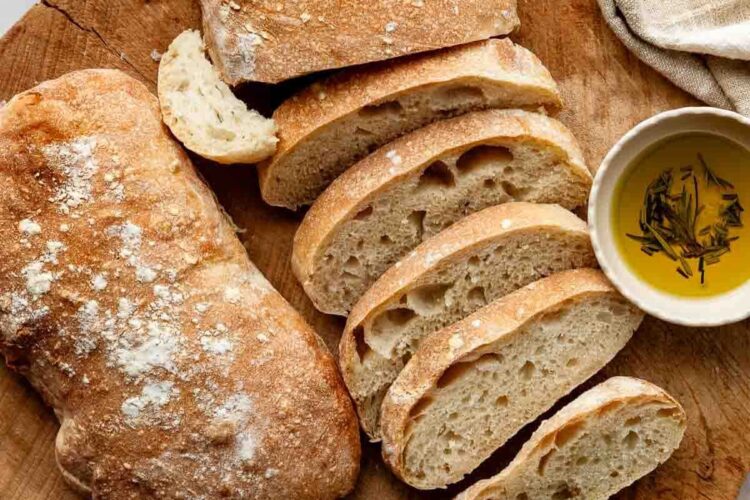
Yummy Gluten Free Ciabatta Rolls
Introduction & Background
Easy Gluten Free Ciabatta Rolls are a re-engineered version of traditional Italian ciabatta, designed specifically for gluten-free baking systems where the natural gluten network is absent. Classic ciabatta originates from Italy and is famous for its irregular, rustic shape, airy crumb, and chewy crust. The original version depends heavily on wheat flour, long fermentation, and gluten development to create its signature open structure.
In traditional baking, gluten acts like a biological scaffold. It stretches during kneading, traps fermentation gases, and holds the bread’s internal structure as it expands in the oven. Without gluten, that scaffold disappears completely, which means gluten-free ciabatta cannot rely on traditional techniques like kneading or stretch-and-fold methods.
Instead, this recipe rebuilds the entire structure using hydration science, starch transformation, and hydrocolloid gel systems. The goal is not to “remove gluten from ciabatta,” but to reconstruct ciabatta behavior using alternative food chemistry principles.
This results in a bread that still has:
- Open, irregular air pockets
- Soft yet structured interior
- Light chew without elasticity
- Crisp, rustic crust
- Slightly moist crumb without gumminess
The “easy” part of this recipe comes from eliminating kneading and complex shaping, replacing them with a rest-and-hydrate system that allows structure to form naturally.
Chef’s Philosophy & Culinary Framework
The philosophy behind Easy Gluten Free Ciabatta Rolls is:
Structure is not created through force—it is formed through hydration time and controlled gel behavior.
In wheat-based bread, structure is mechanical (kneading gluten).
In gluten-free bread, structure is chemical and physical (gel networks + starch behavior + moisture balance).
The key principle is:
“Where gluten once stretched, water and starch must now stabilize.”
This recipe focuses on three core goals:
- Replace gluten elasticity with gel-based structure
- Use high hydration to create open crumb formation
- Control moisture loss to preserve softness and chew
Instead of “working the dough,” we allow it to self-assemble over time.
Core Culinary Systems (Ultra Deep Technical Breakdown)
1. Hydrocolloid Gel Structure System
Since gluten is absent, structural integrity is created using hydrocolloids such as:
- Psyllium husk
- Xanthan gum
When hydrated, these ingredients form a viscoelastic gel network that mimics gluten’s ability to:
- Trap gas bubbles
- Hold structure during expansion
- Maintain crumb stability after baking
Psyllium is especially powerful because it forms a fibrous gel matrix, similar in behavior to gluten strands.
This system replaces:
- Gluten elasticity
- Dough strength
- Structural stretch behavior
2. High Hydration Open Crumb System
Ciabatta-style bread requires very high hydration levels, often 80–100% in wheat versions.
In gluten-free baking, hydration plays a different role:
- Activates starch swelling
- Enables gel formation
- Allows air pocket mobility
- Creates batter-like consistency
Instead of kneadable dough, we work with a high-hydration batter system that thickens naturally during resting.
This hydration is responsible for:
- Large irregular holes
- Soft interior structure
- Light crumb density
However, hydration must be balanced precisely—too much leads to collapse, too little leads to density.
3. No-Knead Self-Structure Formation System
Traditional ciabatta requires intense kneading and folding. This version removes all mechanical development.
Instead, structure is formed through:
- Time
- Hydration absorption
- Gel formation
- Gas retention
During resting:
- Psyllium absorbs water and expands
- Starches swell and thicken mixture
- Yeast (if used) produces gas bubbles
- Air pockets stabilize naturally
This is a passive structure-building system, not an active one.
4. Fermentation Gas Retention System
If yeast is included, it generates carbon dioxide during fermentation.
In gluten bread, gluten traps this gas.
In gluten-free bread, gas is trapped by:
- Hydrocolloid gel networks
- Thickened starch matrix
- Increased viscosity of dough
This system determines:
- Bread rise height
- Internal air pocket formation
- Final crumb openness
Without proper gel strength, gas escapes and bread becomes dense.
5. Starch Gelatinization Structural Lock System
During baking, starch undergoes irreversible transformation:
- Starch granules absorb heat and water
- They swell and rupture
- A semi-solid gel forms
This gel becomes the permanent structure of the bread once cooled.
This process is responsible for:
- Final loaf stability
- Sliceability
- Crumb firmness
It replaces gluten setting entirely.
6. Crust Formation Maillard Reaction System
The crust develops through:
- Evaporation of surface moisture
- Protein-sugar reaction under heat
- Caramelization of starch sugars
This produces:
- Golden rustic crust
- Slight crunch exterior
- Deep toasted aroma
Even without gluten, crust formation is strong due to surface dehydration and starch browning.
7. Air Pocket Stabilization Architecture System
Air pockets are created during fermentation and expanded during baking.
They are stabilized by:
- Gel matrix rigidity
- Starch thickening
- Controlled moisture loss
This creates the signature ciabatta irregular crumb pattern:
- Large holes
- Uneven distribution
- Light structure variation
This randomness is essential to authenticity.
8. Moisture Equilibrium Retention System
Gluten-free bread is extremely sensitive to moisture imbalance.
Three zones must be balanced:
- Interior moisture (softness)
- Crust dryness (structure)
- Overall hydration (crumb stability)
If imbalance occurs:
- Too wet → gummy bread
- Too dry → crumbly bread
- Balanced → soft yet structured loaf
Difficulty, Timing & Yield
Difficulty Level: Medium–Advanced
Preparation Time: 25–30 minutes
Resting Time: 2–3 hours
Baking Time: 30–40 minutes
Cooling Time: 1 hour
Total Time: ~4–5 hours
Yield: 6–10 rolls
Ingredients (Ultra Detailed Functional Breakdown)
Flour Structural System
- 1 cup rice flour
- 1/2 cup tapioca starch
- 1/2 cup potato starch
Function:
- Rice flour → base structure
- Tapioca starch → elasticity mimic
- Potato starch → softness and moisture retention
Together they replicate wheat flour behavior in a gluten-free matrix.
Hydrocolloid Binding System
- 1 tablespoon psyllium husk powder
or - 1 teaspoon xanthan gum
Function:
- Creates gel structure
- Replaces gluten network
- Stabilizes air bubbles
Yeast Fermentation System
- 1 teaspoon active dry yeast
- 1 teaspoon sugar
- 1 cup warm water
Function:
- Produces CO₂ gas
- Drives expansion
- Adds flavor depth
Fat Stabilization System
- 1 tablespoon olive oil
Function:
- Softens crumb
- Improves mouthfeel
- Enhances crust flavor
Salt Balance System
- 1 teaspoon salt
Function:
- Controls fermentation speed
- Enhances flavor balance
Step-by-Step Method (Ultra Detailed Execution System)
Step 1: Yeast Activation Phase
Combine yeast, sugar, and warm water.
Let sit 5–10 minutes until foamy.
This confirms:
- Active fermentation
- Gas production capability
Step 2: Dry System Integration Phase
Mix:
- Rice flour
- Tapioca starch
- Potato starch
- Psyllium husk
- Salt
This ensures uniform structural base distribution.
Step 3: Wet System Integration Phase
Add:
- Yeast mixture
- Olive oil
Mix until fully combined.
Dough will appear sticky and elastic-like in viscosity.
Step 4: Hydration Resting Phase (Critical Step)
Rest dough for 2–3 hours.
During this time:
- Gel network forms
- Starches hydrate fully
- Gas bubbles develop
- Dough thickens naturally
This is where structure is “built internally.”
Step 5: Shaping Phase
Lightly oil hands.
Shape into rustic rolls without deflating air pockets.
Minimal handling is essential.
Step 6: Final Proofing Phase
Rest shaped rolls for 20–30 minutes.
This allows:
- Final gas expansion
- Surface stabilization
Step 7: Baking Phase
Bake at 190–200°C for 30–40 minutes.
During baking:
- Dough expands rapidly
- Crust forms through dehydration
- Interior sets via starch gelatinization
Step 8: Cooling Stabilization Phase
Cool for 1 hour before slicing.
This ensures:
- Internal structure solidifies
- Moisture redistributes evenly
- Crumb stabilizes fully
Texture & Flavor Profile
Perfect Easy Gluten Free Ciabatta Rolls deliver:
- Crisp rustic golden crust
- Soft, airy interior
- Open irregular crumb structure
- Light chew without elasticity
- Mild nutty starch flavor
Advanced Variations
Olive Herb Ciabatta
- Add olives + rosemary
Mediterranean flavor profile.
Garlic Butter Ciabatta
- Add garlic powder + butter
Rich savory version.
Seeded Ciabatta
- Add flax, chia, sunflower seeds
Adds crunch and nutrition.
Cheese Filled Version
- Add mozzarella chunks
Creates soft molten pockets.
Advanced Tips
- Always maintain high hydration balance
- Do not overmix after combining ingredients
- Handle dough gently to preserve air pockets
- Allow full resting time for structure formation
- Cool completely before slicing
Common Mistakes & Fixes
Dense Bread
Cause:
Low hydration or weak gel formation
Fix:
Increase water or psyllium slightly
Flat Rolls
Cause:
Inactive yeast or poor proofing
Fix:
Ensure yeast is fresh and active
Gummy Interior
Cause:
Underbaking or excess moisture
Fix:
Bake longer and reduce hydration slightly
No Air Holes
Cause:
Overmixing or collapsed gas structure
Fix:
Mix gently and avoid deflating dough
Storage & Reheating
- Store 2–3 days at room temperature
- Freeze for longer storage
- Toast before serving to restore texture
Serving Suggestions
Serve with:
- Olive oil and balsamic vinegar
- Soups and stews
- Sandwich fillings
- Garlic butter spreads
Final Thoughts
Easy Gluten Free Ciabatta Rolls demonstrate how modern baking science can reconstruct traditional bread structures without gluten by relying on hydration physics, gel networks, and controlled fermentation behavior.
They deliver:
- Rustic crust
- Airy open crumb
- Soft structured interior
- Fully gluten-free functionality
At their core, they prove:
When gluten is removed, structure is not lost—it is redesigned through water, starch, and time.
