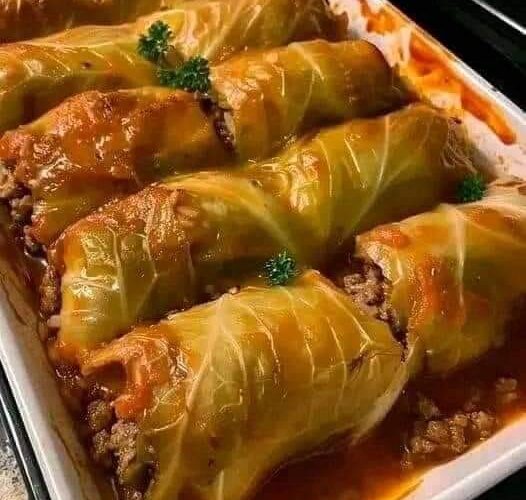
Stuffed Cabbage Rolls – Recipe
Introduction & Background
Stuffed Cabbage Rolls are a deeply rooted, cross-cultural comfort dish that has evolved over centuries through necessity, tradition, and culinary ingenuity. Found in Eastern European kitchens, Middle Eastern households, and even parts of Central Asia, this dish represents one of the earliest examples of food encapsulation techniques, where a filling is wrapped inside a natural edible layer and cooked slowly to develop flavor and tenderness.
Historically, cabbage rolls emerged as a way to stretch limited resources. A small portion of meat could be extended using grains such as rice or barley, wrapped in cabbage leaves, and cooked in a flavorful liquid to feed an entire family. This method not only maximized ingredients but also enhanced flavor through long cooking times.
Different regions developed their own identities of this dish:
- Eastern Europe: tomato-based sauces and beef/pork fillings
- Middle East: lighter, often lemon-based broths with rice-focused fillings
- Balkan variations: richer sauces with paprika and herbs
Despite these variations, the core idea remains unchanged: a balanced, slow-cooked, wrapped dish where every component contributes to a unified flavor experience.
This recipe is not just about cooking—it is about understanding how structure, moisture, and time interact to create something deeply satisfying.
Chef’s Philosophy & Culinary Framework
The philosophy behind Stuffed Cabbage Rolls is:
Encapsulation transforms separate ingredients into a unified system.
Unlike open dishes where flavors remain distinct, this method creates a closed environment where:
- Filling releases juices
- Cabbage absorbs and softens
- Sauce penetrates both layers
This leads to flavor integration rather than separation.
A properly made cabbage roll should not taste like cabbage + meat + rice individually—it should taste like one cohesive, deeply developed bite.
The chef’s goal is to control:
- Moisture movement
- Texture transitions
- Flavor balance over time
Core Culinary Systems (Ultra Deep Technical Breakdown)
1. Leaf Softening & Structural Flexibility System
Raw cabbage leaves are rigid due to their cellular structure.
When exposed to heat (boiling or steaming):
- Cell walls weaken
- Fibers soften
- Leaves become flexible
This transformation is essential because:
- Leaves must bend without breaking
- They must wrap tightly around filling
- They must hold shape during cooking
Properly softened cabbage becomes:
- Tender but not mushy
- Flexible but not fragile
2. Filling Matrix Design System
The filling is a multi-component matrix designed to balance density, moisture, and flavor.
Typical structure:
- Meat → protein and richness
- Rice → expansion and moisture absorption
- Aromatics → flavor base
During cooking:
- Rice absorbs liquid and expands
- Meat releases juices
- Everything binds into a cohesive interior
The filling must be:
- Loose enough to cook evenly
- Tight enough to hold shape
3. Moisture Exchange & Retention System
Stuffed cabbage rolls operate on a controlled moisture exchange system.
Inside the roll:
- Rice absorbs liquid
- Meat releases juices
Outside the roll:
- Sauce surrounds and hydrates
- Cabbage traps moisture
This creates a balanced internal environment where:
- Filling stays juicy
- Rice cooks fully
- Nothing dries out
4. Sauce Penetration & Flavor Infusion System
The sauce acts as:
- Cooking medium
- Flavor carrier
- Moisture regulator
As the rolls simmer:
- Sauce penetrates cabbage
- Flavor moves inward
- Acidity balances richness
Over time, sauce thickens and becomes more concentrated, coating the rolls evenly.
5. Thermal Transformation & Slow Cooking System
Slow cooking is essential for this dish.
At low temperatures:
- Meat cooks gently without toughening
- Rice hydrates evenly
- Cabbage softens fully
- Flavors merge gradually
Fast cooking would result in:
- Tough cabbage
- Undercooked rice
- Uneven flavor
6. Compression & Shape Stability System
Rolling technique determines structural integrity.
A proper roll must:
- Hold filling securely
- Maintain shape during cooking
- Prevent filling leakage
This is achieved through:
- Folding sides inward
- Rolling tightly
- Placing seam-side down
Difficulty, Timing & Yield
Difficulty Level: Medium (Technique-focused)
Preparation Time: 40–50 minutes
Cooking Time: 1.5–2 hours
Resting Time: 15 minutes
Total Time: ~2.5 hours
Servings: 5–7 portions
Ingredients (Ultra Detailed Functional Breakdown)
Cabbage Wrapper System
- 1 large green cabbage
Function:
- Encases filling
- Protects internal moisture
- Softens into tender outer layer
Protein & Grain Filling System
- 500–700g ground meat (beef, chicken, or lamb)
- 1/2 to 3/4 cup uncooked rice
Function:
- Meat provides richness
- Rice expands and absorbs liquid
- Together create balanced filling
Aromatic Base System
- 1 large onion (finely chopped)
- 2–3 cloves garlic
Function:
- Builds flavor foundation
- Adds depth and aroma
Seasoning System
- Salt
- Black pepper
- Paprika
- Optional herbs (parsley, dill)
Function:
- Enhances natural flavors
- Balances richness
Sauce System
- 2–3 cups tomato sauce
- 1–2 tablespoons tomato paste
- 1 teaspoon sugar
- 1–2 tablespoons oil
Function:
- Cooking medium
- Adds acidity and depth
- Prevents dryness
Step-by-Step Method (Ultra Detailed Execution)
Step 1: Cabbage Preparation Phase
Boil a large pot of water.
Remove core from cabbage.
Place cabbage in boiling water.
As outer leaves soften:
- Peel them off carefully
- Repeat until enough leaves are collected
Trim thick stems for easier rolling.
Step 2: Filling Preparation Phase
In a large bowl, combine:
- Ground meat
- Rice
- Onion
- Garlic
- Seasonings
Mix gently until evenly combined.
Avoid overmixing to prevent dense texture.
Step 3: Rolling & Encapsulation Phase
Place filling near base of leaf.
Fold sides inward.
Roll tightly upward.
Ensure compact but not overly tight rolls.
Step 4: Layering & Assembly Phase
Spread a layer of sauce at bottom of pot.
Arrange rolls seam-side down.
Stack in layers if needed.
Pour remaining sauce over top.
Step 5: Slow Cooking Phase
Cook covered:
- Stove: low heat for 1.5–2 hours
OR - Oven: 180°C for 1.5–2 hours
During cooking:
- Rice expands
- Meat cooks gently
- Sauce thickens
- Cabbage becomes tender
Step 6: Resting & Stabilization Phase
Let rest for 15 minutes.
This allows:
- Sauce to settle
- Rolls to firm up
- Flavors to intensify
Texture & Flavor Profile
A perfectly executed stuffed cabbage roll delivers:
- Silky, tender cabbage exterior
- Juicy, flavorful filling
- Fully cooked, soft rice
- Rich, slightly tangy sauce
- Balanced savory depth
The bite should feel cohesive, not layered separately.
Advanced Variations
Vegetarian Version
- Replace meat with lentils, mushrooms, or beans
Low-Carb Version
- Use cauliflower rice instead of regular rice
Spiced Version
- Add cumin, chili flakes, or allspice
Creamy Finish Version
- Stir sour cream into sauce before serving
Advanced Tips for Perfection
- Choose large cabbage for easier rolling
- Do not overfill leaves
- Keep rolls tightly packed in pot
- Add broth if liquid reduces too much
- Cook low and slow for best results
Common Mistakes & Solutions
Tough Leaves
Cause:
Under-blanching
Fix:
Cook cabbage longer before rolling
Dry Filling
Cause:
Insufficient liquid
Fix:
Increase sauce or cooking time
Loose Rolls
Cause:
Poor rolling technique
Fix:
Fold tightly and place seam-side down
Undercooked Rice
Cause:
Short cooking time
Fix:
Extend cooking or pre-soak rice
Storage & Meal Prep Optimization
- Refrigerate up to 4–5 days
- Freeze up to 2 months
- Reheat gently with added sauce
Flavor improves after resting overnight.
Serving Suggestions
Serve with:
- Mashed potatoes
- Fresh bread
- Yogurt or sour cream
- Fresh herbs
Final Thoughts
Stuffed Cabbage Rolls are more than just a recipe—they are a demonstration of how time, structure, and technique transform simple ingredients into something deeply comforting and complex.
They deliver:
- Tender, slow-cooked texture
- Balanced moisture and richness
- Deep, integrated flavor
- Cultural tradition in every bite
At their core, they represent one of the most powerful ideas in cooking:
When ingredients are carefully wrapped, gently cooked, and allowed to evolve together, they create a harmony that no single component could achieve on its own.
