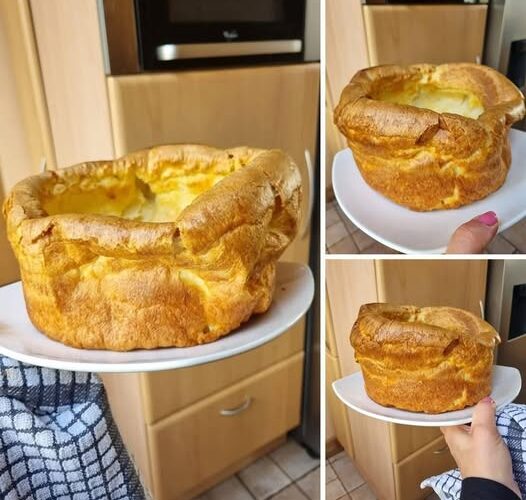
Yorkshire Pudding – Recipe
Introduction & Background
Yorkshire Pudding is one of the most fascinating and deceptively simple creations in traditional cooking. Made from just eggs, flour, milk, and fat, it transforms inside a hot oven into towering, golden, crisp structures with hollow centers and airy interiors. While it appears humble, it is actually one of the most precision-dependent recipes in classic cuisine.
Originating in the 18th century in the United Kingdom, Yorkshire pudding began as a practical dish. Cooks would place batter beneath roasting meat to catch dripping fat, effectively turning leftover heat and fat into a flavorful and filling component of the meal. Over time, it evolved into a centerpiece of the iconic British Sunday roast.
What makes Yorkshire pudding extraordinary is that it relies entirely on physics and chemistry rather than chemical leavening agents. There is no yeast, no baking powder—just:
- Steam generation
- Protein setting
- Starch gelatinization
- Rapid heat expansion
This recipe is designed to push Yorkshire pudding to its highest level, helping you achieve:
- Maximum rise and dramatic height
- Crisp, deeply browned exterior
- Soft, custard-like interior
- Stable hollow structure
- Consistent, repeatable results
What This Dish Really Is (Structural Identity)
Yorkshire pudding is a high-hydration, steam-leavened batter system activated by thermal shock.
It involves three core systems:
1. Liquid Batter Matrix
A mixture of eggs, milk, and flour forms a fluid base.
2. High-Temperature Fat Activation
Hot fat instantly heats the batter upon contact.
3. Steam Expansion & Structural Setting
Water converts to steam, expanding the batter while proteins and starches set.
Unlike cakes:
- It does not rely on trapped air from mixing
- It relies on rapid steam expansion under extreme heat
You can define it as:
a rapidly expanding batter that uses steam pressure to create a hollow, crispy structure stabilized by proteins and starch
Core Texture Goals (Professional Benchmark)
A perfectly executed Yorkshire pudding should achieve:
- Tall, dramatic rise with defined walls
- Deep golden to dark brown exterior
- Crisp, almost shell-like outer layer
- Soft, slightly custardy interior
- Large hollow center for fillings or gravy
The perfect bite experience is:
crispy shell → airy structure → soft inner layer
Ingredient System (Ultra Detailed Functional Breakdown)
1. Eggs (Primary Structural Engine)
- 4 large eggs
Function:
- Provide protein network
- Trap steam during expansion
- Stabilize final structure
Advanced Insight:
Egg proteins denature and coagulate at specific temperatures, locking in the expanded shape.
2. Flour (Framework Builder)
- 1 cup all-purpose flour
Function:
- Provides starch
- Forms structural backbone
- Supports expansion
Key Note:
Too much flour → dense pudding
Too little → weak structure
3. Milk (Hydration & Steam Source)
- 1 to 1¼ cups milk
Function:
- Hydrates flour
- Provides water for steam
- Controls batter fluidity
4. Salt (Flavor Enhancer)
- ½–1 tsp salt
Function:
- Enhances overall taste
5. Fat (Critical Thermal Component)
- Beef drippings (traditional) or oil
Function:
- Transfers heat rapidly
- Creates crisp exterior
- Initiates expansion
Deep Food Science Breakdown (Advanced Level)
1. Steam Generation (Primary Rising Force)
The most important mechanism:
- Water in batter turns into steam
- Steam expands rapidly
- Pressure pushes batter upward
This creates height and hollow structure.
2. Thermal Shock Activation
When batter hits hot fat:
- Immediate heat transfer occurs
- Rapid steam production begins
- Outer layer starts setting
This sudden expansion is critical.
3. Egg Protein Coagulation
As temperature rises:
- Proteins unfold
- Bonds form
- Structure stabilizes
This prevents collapse.
4. Starch Gelatinization
Flour absorbs heat and liquid:
- Swells
- Thickens
- Strengthens structure
5. Oven Spring Effect
High oven temperature:
- Maximizes expansion
- Creates large internal cavities
6. Fat Interaction with Batter
Fat:
- Fries outer surface
- Creates crisp texture
- Enhances flavor
7. Cooling Stabilization Phase
After removal:
- Structure firms up
- Steam escapes
- Crispness increases
Step-by-Step Method (Ultra Detailed Execution)
Step 1: Batter Preparation
Whisk together:
- Eggs
- Milk
- Flour
- Salt
Mix until smooth and lump-free.
Step 2: Batter Resting Phase
Rest batter for 45–90 minutes.
This allows:
- Full hydration of flour
- Gluten relaxation
- Improved rise
Step 3: Preheat Oven (Critical Step)
Preheat to 230°C (446°F).
High heat is non-negotiable.
Step 4: Heat Fat to Proper Temperature
Add fat to muffin tray.
Heat until:
- Very hot
- Almost smoking
This ensures proper expansion.
Step 5: Pour Batter
Carefully pour batter into hot fat.
You should hear an immediate sizzle.
Step 6: Initial Expansion Phase
Place tray in oven immediately.
Do NOT open oven door.
Step 7: Baking Phase
Bake for 20–25 minutes.
Observe:
- Rapid rise
- Browning
- Hollow formation
Step 8: Final Browning Phase
Allow deeper color to develop.
This ensures crispness.
Step 9: Removal & Resting
Remove and let sit briefly.
Serve immediately.
Texture & Flavor Profile
Perfect Yorkshire pudding delivers:
- Crispy, golden shell
- Light, airy interior
- Slightly eggy, savory flavor
- Richness from fat
Common Mistakes & Fixes
Flat Puddings
Cause: Low heat
Fix: Increase oven temperature
No Rise
Cause: Cold fat
Fix: Heat fat thoroughly
Dense Interior
Cause: Thick batter
Fix: Adjust liquid ratio
Soggy Texture
Cause: Underbaking
Fix: Extend bake time
Collapsed Structure
Cause: Opening oven early
Fix: Keep oven closed
Advanced Variations
Giant Yorkshire Pudding
Bake in large pan.
Mini Appetizer Version
Use mini molds.
Stuffed Yorkshire Pudding
Fill with meat, vegetables, or gravy.
Sweet Version
Add sugar and serve with syrup.
Herb-Infused Version
Add herbs to batter.
Storage & Reheating
- Best eaten fresh
- Reheat in oven for crispness
Serving Ideas
- With roast beef
- With gravy
- As appetizer
- With savory fillings
- As snack
Final Thoughts
Yorkshire pudding is one of the clearest demonstrations of how cooking is driven by science. With no baking powder or yeast, it relies entirely on steam, heat, and structural chemistry to achieve its dramatic rise and crisp texture.
It delivers:
- Tall, airy structure
- Crispy exterior
- Soft interior
- Classic flavor
At its core, it proves:
When heat, steam, and structure are perfectly controlled, even the simplest mixture of eggs, milk, and flour can transform into a dramatic, crispy, and beautifully risen dish that stands as one of the greatest examples of traditional cooking mastery.
