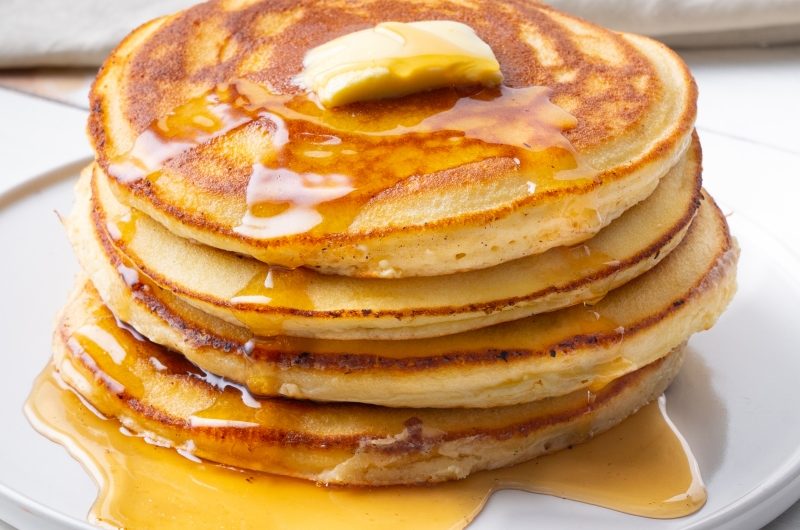
Pancakes are one of the most globally widespread cooked batter foods, appearing in countless culinary traditions across history. While modern versions are often associated with breakfast culture in the United States, their origins stretch far deeper, with early flat cakes made from grain and water cooked on hot stones or pans appearing in ancient civilizations long before modern ovens existed.
In refined European culinary systems, especially in France, pancakes evolved into extremely thin crêpes, while thicker, fluffier versions developed elsewhere through the introduction of chemical leavening agents like baking powder. These innovations transformed pancakes from dense flatbreads into aerated, soft, stackable cakes.
Modern pancakes are essentially a rapid chemical-leavened batter system, designed to create instant softness, controlled browning, and internal air structure within minutes of cooking. Unlike yeast-based breads that rely on fermentation over time, pancakes rely on instant gas expansion physics inside a heated starch-protein matrix.
At a deeper level, pancakes are not just food—they are a controlled transformation of liquid batter into a semi-structured foam-like cake using heat as the triggering mechanism.
Chef’s Philosophy & Culinary Framework
The philosophy behind perfect pancakes is:
Minimal mixing + controlled gas release + precise heat timing = soft lift architecture system
Unlike bread or pastry, pancakes do not require strength. They require delicacy of structure.
The key idea:
“A pancake is not built—it is allowed to rise and set without interference.”
This recipe focuses on:
- Preserving air pockets instead of destroying them
- Avoiding gluten overdevelopment
- Managing heat so structure sets gradually
- Balancing softness with surface caramelization
Pancakes succeed when they feel light, tender, and slightly springy—not dense or chewy.
Core Culinary Systems (Ultra Deep Technical Breakdown)
1. Chemical Leavening Expansion System
The primary rising force in pancakes comes from baking powder (or baking soda + acid combinations). When heated, these compounds release carbon dioxide gas.
Inside the batter:
- Gas bubbles form rapidly
- Bubbles expand as temperature rises
- Batter lifts and thickens vertically
This creates a temporary internal foam structure that defines pancake fluffiness.
2. Gluten Formation Control System
Flour contains gluten-forming proteins (gliadin and glutenin). When hydrated and mixed, they can form elastic networks.
However, in pancakes:
- Excess gluten = chewy texture
- Proper gluten = structural support
The goal is controlled minimal gluten formation:
- Mix only until combined
- Avoid aggressive stirring
- Keep batter slightly lumpy
This ensures tenderness instead of chewiness.
3. Fat Coating Tenderization System
Fat (butter or oil) coats flour particles and interferes with gluten bonding.
This results in:
- Softer texture
- Reduced toughness
- More melt-in-mouth perception
Fat also improves browning by enhancing heat transfer on the pan surface.
4. Egg Protein Stabilization System
Eggs serve multiple structural roles:
- Bind ingredients together
- Provide elasticity
- Help trap air within batter
When heated:
- Egg proteins coagulate
- Structure locks in place
- Pancake becomes stable but soft
Eggs are the structural scaffolding of pancake integrity.
5. Hydration and Batter Viscosity Control System
Milk or liquid determines batter behavior:
- High viscosity → thick, tall pancakes
- Low viscosity → thin, flat pancakes
Correct hydration ensures:
- Controlled spread on pan
- Even heat distribution
- Balanced rise
Batter should flow slowly but not pour like water.
6. Thermal Surface Reaction System (Maillard Browning)
When batter contacts a hot surface:
- Proteins and sugars react
- Brown crust forms
- Aroma compounds develop
This reaction creates:
- Golden color
- Slight crisp exterior
- Deep cooked flavor notes
This is the sensory identity of pancakes.
7. Internal Steam Expansion System
During cooking:
- Water inside batter turns to steam
- Steam expands trapped bubbles
- Internal lift increases
This is a secondary rising mechanism that supports chemical leavening.
8. Bubble Stabilization and Collapse System
Air bubbles behave dynamically:
- Some expand
- Some burst
- Some stabilize into structure
Proper batter consistency ensures enough bubbles survive to maintain fluffiness.
9. Flip Transition Structural Lock System
Flipping pancakes is a critical structural moment.
Before flipping:
- Bottom must be set
- Surface must show bubbles and slight dryness
After flipping:
- Structure locks in place
- Second side cooks gently
Incorrect flipping destroys internal air structure.
10. Stack Heat Retention System
Stacking pancakes creates:
- Heat insulation between layers
- Moisture redistribution
- Slight softening of edges
This improves texture and enhances flavor integration when syrup or butter is added.
Difficulty, Timing & Yield
Difficulty Level: Easy
Preparation Time: 10–15 minutes
Cooking Time: 15–20 minutes
Total Time: ~30–35 minutes
Yield: 6–10 pancakes
Ingredients (Ultra Detailed Functional Breakdown)
Dry Structural System
- 1½ cups all-purpose flour
- 2 tablespoons sugar
- 2 teaspoons baking powder
- ¼ teaspoon salt
Function:
- Structural base
- Gas expansion trigger
- Flavor balancing
Wet Emulsion System
- 1 cup milk
- 1 large egg
- 2 tablespoons melted butter (or neutral oil)
- 1 teaspoon vanilla extract (optional)
Function:
- Moisture carrier
- Fat tenderizer
- Flavor enhancer
- Protein binder
Step-by-Step Method (Ultra Detailed Execution System)
Step 1: Dry Blending Phase
Combine:
- Flour
- Baking powder
- Sugar
- Salt
Mix evenly to distribute leavening agents.
Step 2: Wet Emulsion Phase
In a separate bowl whisk:
- Egg
- Milk
- Melted butter
- Vanilla
Until smooth and unified.
Step 3: Batter Formation Phase
Combine wet and dry mixtures.
Stir gently until just combined.
Batter should remain slightly lumpy.
Step 4: Resting Phase (Structural Relaxation System)
Let batter rest 5–10 minutes.
This allows:
- Gluten relaxation
- Bubble stabilization
- Hydration balancing
Step 5: Cooking Phase
Heat pan to medium temperature.
Pour batter into round shapes.
Cook until bubbles form and edges set.
Step 6: Flip Phase
Flip once carefully.
Cook until second side is golden.
Step 7: Serving Phase
Serve immediately while warm and fluffy.
Texture & Flavor Profile
Perfect pancakes deliver:
- Soft, cloud-like interior
- Golden caramelized crust
- Light buttery aroma
- Mild sweetness
- Airy sponge-like bite
Advanced Variations
Banana Pancakes
- Add mashed ripe banana
Chocolate Pancakes
- Add cocoa powder or chocolate chips
Oat Pancakes
- Replace part of flour with oats
Buttermilk Pancakes
- Use buttermilk instead of milk for tangy depth
Protein Pancakes
- Add protein powder (adjust liquid balance)
Advanced Tips
- Do not overmix batter
- Use medium heat only
- Wait for bubbles before flipping
- Keep batter slightly thick, not runny
- Use fresh baking powder for maximum rise
Common Mistakes & Fixes
Flat Pancakes
Cause:
Inactive baking powder or overmixing
Fix:
Use fresh leavening + gentle mixing
Rubbery Texture
Cause:
Excess gluten development
Fix:
Stir less, keep batter slightly lumpy
Burnt Outside, Raw Inside
Cause:
Too high heat
Fix:
Lower pan temperature
Dry Pancakes
Cause:
Too much flour or low hydration
Fix:
Adjust milk quantity
Storage & Reheating
- Store in fridge up to 2–3 days
- Reheat in pan or toaster
- Add butter or syrup to restore softness
Serving Suggestions
Serve with:
- Maple syrup
- Honey
- Butter
- Fresh fruit
- Chocolate sauce
- Yogurt or cream
Final Thoughts
Pancakes are a perfect example of how simple ingredients can produce complex texture systems when heat, air, and timing are precisely balanced.
They deliver:
- Fast preparation
- Highly customizable flavor base
- Soft, fluffy structure
- Universal appeal across cultures
At their core, pancakes prove:
When batter is treated gently and heat is controlled precisely, liquid can transform into a structured, airy cake in minutes without fermentation or complexity
