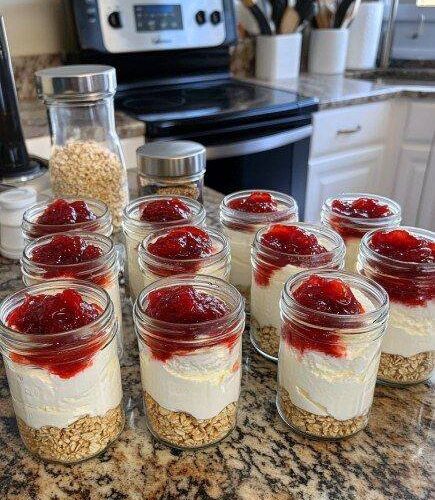
Protein Cheesecake Jars
Introduction & Background
High Protein Cheesecake Jars represent a refined evolution of one of the world’s most beloved desserts—cheesecake—transformed into a modern, functional, no-bake, layered system that prioritizes nutrition without sacrificing indulgence. Traditional cheesecake, rooted in European dessert history, is typically dense, rich, and built on a foundation of cream cheese, eggs, sugar, and a baked crust. While iconic, it is often calorie-heavy and lacks macronutrient balance, especially in terms of protein.
This re-engineered version shifts cheesecake from a purely indulgent dessert into a performance-oriented food structure, suitable for:
- Post-workout recovery
- High-protein snacking
- Meal-prep desserts
- Controlled portion eating
The “jar” format is more than just presentation—it is a structural innovation. Instead of slicing a whole cake, each jar becomes an independent, perfectly layered unit with:
- Defined texture zones
- Controlled serving size
- Enhanced flavor layering
- Portable convenience
This dessert merges:
- Classic cheesecake flavor
- Protein-focused nutrition
- Layered dessert engineering
- No-bake convenience
Chef’s Philosophy & Culinary Framework
The philosophy behind High Protein Cheesecake Jars is:
Cold-set structuring + protein integration + layered texture design = functional dessert architecture
Unlike baked cheesecake, which depends on heat-induced coagulation of eggs and fats, this version relies on thermal absence—meaning structure is achieved without baking.
The key idea:
“In no-bake desserts, stability comes from balance, not heat.”
This recipe is designed around three core pillars:
- Protein must integrate seamlessly into cream—not disrupt it
- Each layer must serve a textural and functional purpose
- Chilling is not optional—it is the final structural phase
Core Culinary Systems (Ultra Deep Technical Breakdown)
1. Cold-Set Structural Stabilization System
In traditional cheesecake:
- Heat sets eggs and proteins
- Structure becomes firm after baking
In this no-bake system:
- Fat (cream cheese/yogurt) solidifies under cold temperatures
- Proteins settle and bind
- Mixture thickens gradually
This creates a semi-solid, spoonable structure that mimics baked cheesecake without thermal processing.
2. Protein Integration & Dispersion System
Protein powder is one of the most challenging ingredients in dessert engineering.
Potential issues:
- Clumping
- Grainy texture
- Chalky mouthfeel
To solve this:
- Protein must be mixed gradually
- Combined with enough moisture (milk/yogurt)
- Balanced with fat (cream cheese or yogurt)
This ensures:
- Smooth texture
- Even distribution
- Cream-like consistency
3. Emulsion Stability System (Cream Phase)
The cheesecake layer is a multi-phase emulsion, combining:
- Fat (cream cheese, yogurt)
- Water (milk, yogurt moisture)
- Proteins (dairy + protein powder)
A stable emulsion results in:
- Silky texture
- Uniform flavor
- No separation
If improperly mixed:
- Water separates
- Texture becomes uneven
4. Crust Compression & Binding System
The base layer replicates a cheesecake crust.
Instead of baking, it relies on:
- Fat binding (butter or nut butter)
- Mechanical compression (pressing into jar)
This creates:
- Firm base
- Slight crunch
- Structural foundation
The crust must be:
- Compact enough to hold
- Loose enough to scoop
5. Layered Texture Contrast System
Each jar is designed with intentional contrast zones:
Layer 1: Crust
- Crunchy
- Dense
Layer 2: Cheesecake Cream
- Smooth
- Soft
- Rich
Layer 3: Topping
- Fresh / crunchy / sweet
This creates a multi-sensory eating experience.
6. Sweetness Calibration System
Protein desserts often suffer from imbalance.
Too little sweetness:
- Highlights protein bitterness
Too much:
- Masks natural flavors
Sweetness must:
- Balance acidity (yogurt/cream cheese)
- Complement toppings
- Avoid overpowering
7. Moisture Equilibrium & Hydration System
Hydration determines texture quality.
Sources of moisture:
- Yogurt
- Milk
- Cream cheese water content
Too much moisture:
- Runny mixture
Too little:
- Thick, dry, chalky texture
Balance creates:
- Smooth spoonable cream
- Stable structure after chilling
8. Chilling & Molecular Stabilization System
Refrigeration is a structural phase, not just storage.
During chilling:
- Fat solidifies
- Proteins stabilize
- Moisture redistributes
- Flavors merge
This transforms the mixture into a cohesive dessert.
9. Flavor Layer Infusion System
As jars rest:
- Flavors move between layers
- Crust absorbs slight moisture
- Cream absorbs topping aroma
This creates a harmonized flavor system.
10. Portion Control & Nutritional Structuring System
Each jar acts as:
- A pre-measured serving
- A macro-controlled dessert
- A repeatable unit
This is ideal for:
- Fitness routines
- Meal planning
- Controlled indulgence
Difficulty, Timing & Yield
Difficulty Level: Easy
Preparation Time: 20–25 minutes
Chilling Time: 2–4 hours (best overnight)
Total Time: ~3–5 hours
Yield: 4–5 jars
Ingredients (Ultra Detailed Functional Breakdown)
Crust Layer System
- 1 cup crushed biscuits, oats, or graham crackers
- 3 tablespoons melted butter or peanut butter
Function:
- Structural base
- Texture contrast
- Flavor foundation
Cheesecake Protein Cream System
- 1 cup Greek yogurt or cream cheese
- 1/2 cup cottage cheese (optional but boosts protein significantly)
- 1/3–1/2 cup protein powder (vanilla or unflavored)
- 2–4 tablespoons honey or sweetener
- 1 teaspoon vanilla extract
- 2–5 tablespoons milk (adjust consistency)
Function:
- Cream body
- Protein density
- Texture formation
Topping & Finishing System
- Fresh berries
- Chocolate chips
- Nut butter drizzle
- Granola or nuts
Function:
- Flavor contrast
- Texture diversity
- Visual presentation
Step-by-Step Method (Ultra Detailed Execution System)
Step 1: Crust Formation & Compression Phase
Combine:
- Crushed base ingredients
- Melted butter or nut butter
Mix until evenly coated.
Press firmly into bottom of jars.
This creates a stable base layer.
Step 2: Cream Base Blending Phase
In a bowl or blender, combine:
- Greek yogurt / cream cheese
- Cottage cheese
- Protein powder
- Sweetener
- Vanilla
Blend until completely smooth.
Step 3: Consistency Adjustment Phase
Add milk gradually.
Mix until texture is:
- Thick
- Smooth
- Spoonable
Avoid making it too runny.
Step 4: Layer Assembly Phase
Spoon cheesecake mixture over crust.
Smooth evenly.
Tap jars lightly to remove air pockets.
Step 5: Topping Integration Phase
Add toppings:
- Fruit for freshness
- Chocolate for richness
- Nuts for crunch
Step 6: Chilling & Stabilization Phase
Refrigerate for at least 2–4 hours.
Best results after overnight chilling.
Texture & Flavor Profile
Perfect High Protein Cheesecake Jars deliver:
- Creamy, smooth cheesecake layer
- Slight crunch from crust
- Balanced sweetness
- Rich yet light mouthfeel
- Fresh or indulgent topping contrast
Advanced Variations
Chocolate Protein Cheesecake Jars
- Add cocoa powder to cream
Strawberry Swirl Cheesecake
- Add fruit puree swirl
Peanut Butter Cheesecake
- Add peanut butter into cream
Cookies & Cream Version
- Add crushed cookies
Keto Version
- Use almond flour crust + sugar-free sweetener
Advanced Tips
- Blend thoroughly for smoothest texture
- Adjust liquid slowly
- Use high-quality protein powder
- Chill long enough for proper structure
- Taste before assembling
Common Mistakes & Fixes
Grainy Texture
Cause:
Poor mixing
Fix:
Blend longer or use blender
Runny Cheesecake
Cause:
Too much liquid
Fix:
Reduce milk or chill longer
Too Thick / Chalky
Cause:
Too much protein
Fix:
Add more yogurt or milk
Bland Flavor
Cause:
Insufficient sweetness or vanilla
Fix:
Adjust flavor balance
Storage & Shelf Life
- Store in fridge up to 3–4 days
- Keep sealed for freshness
- Do not freeze (texture damage)
Serving Suggestions
Serve as:
- Post-workout dessert
- Healthy snack
- Breakfast treat
- Meal prep dessert
Pair with:
- Coffee
- Smoothies
- Protein shakes
Final Thoughts
High Protein Cheesecake Jars are a perfect demonstration of how traditional desserts can be transformed into functional, nutritionally optimized systems without losing their indulgent identity.
They deliver:
- High protein content
- Smooth cheesecake texture
- No-bake convenience
- Customizable flavor options
At their core, they prove:
When structure, nutrition, and flavor are engineered together, dessert becomes more than indulgence—it becomes a functional experience.
