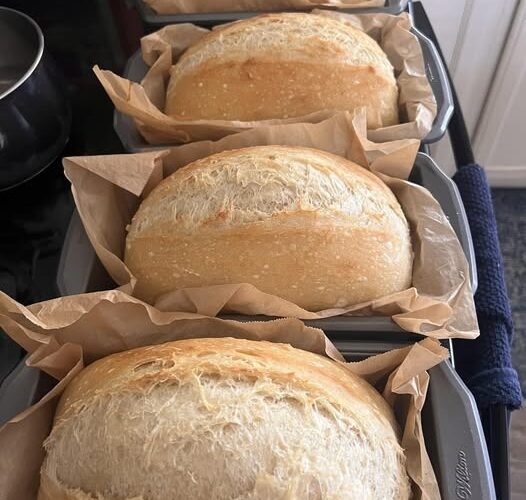
Yummy Gluten-Free Bread – Recipe
Introduction & Background
Creating truly fluffy and soft gluten-free bread is one of the most advanced challenges in baking. Traditional bread depends on gluten—a protein that forms a stretchy, elastic network capable of trapping air and giving bread its structure. Without gluten, achieving that same lightness and flexibility requires a completely different approach.
Gluten-free bread has become essential for people with conditions like Celiac disease, as well as those choosing gluten-free lifestyles. Over the past decade, gluten-free baking has evolved into a refined science, especially in regions like the United States, where alternative flour blends and binding systems have been perfected.
Unlike regular bread, gluten-free bread is not about kneading and developing elasticity. Instead, it is about engineering structure through hydration, binding agents, and controlled baking.
The goal of this recipe is to produce bread that is:
- Soft and airy like bakery bread
- Moist but not gummy
- Flexible enough for sandwiches
- Stable enough to slice cleanly
At its core, this bread is a carefully balanced system of starches, binders, liquids, and gas expansion working together without gluten.
Chef’s Philosophy & Structural Approach
The philosophy behind this bread is:
Hydration + binding + aeration + controlled baking = gluten-free bread that mimics traditional structure
Since gluten is missing, we must rebuild its functions manually:
- Elasticity → replaced by psyllium or xanthan gum
- Structure → replaced by starch gelatinization
- Gas retention → supported by binders
- Softness → controlled through hydration and fat
The key idea:
“Gluten-free bread succeeds when you stop treating it like dough and start treating it like a structured batter that sets into bread.”
Deep Technical Breakdown (Full Baking Science Explained)
1. Flour Composition System
Gluten-free flour is not one ingredient—it is a blend.
Typical components:
- Rice flour → bulk and neutral flavor
- Tapioca starch → elasticity and chew
- Potato starch → softness and moisture retention
Each plays a role:
- Too much rice flour → dry bread
- Too much starch → gummy texture
Balance is everything.
2. Binder Network Formation
Since gluten is absent, binders are essential.
Xanthan Gum
- Creates viscosity
- Helps trap gas
- Improves structure
Psyllium Husk (Superior Option)
- Forms gel when hydrated
- Mimics gluten elasticity
- Creates flexible crumb
When hydrated, psyllium creates a gel matrix that acts like gluten strands.
3. High Hydration Requirement
Gluten-free dough is very different:
- It is wetter than normal dough
- Often resembles thick batter
Why?
- Starches absorb more liquid
- Binders need water to activate
- Soft texture depends on moisture
Without enough hydration → dense bread
Too much hydration → collapsed structure
4. Yeast Fermentation and Gas Production
Yeast feeds on sugar and produces CO₂ gas.
This gas:
- Expands the mixture
- Creates air pockets
- Forms fluffy crumb
The challenge:
Without gluten, gas escapes easily—so binders must trap it.
5. Gas Retention System
This is the hardest part of gluten-free baking.
Gas must be:
- Produced by yeast
- Held by binders
- Stabilized by starches during baking
If not retained:
- Bread becomes dense
- No rise occurs
6. Starch Gelatinization Process
During baking:
- Starches absorb heat and liquid
- They swell and thicken
- Structure becomes solid
This replaces gluten’s role in forming crumb structure.
7. Fat Enrichment System
Fat improves:
- Softness
- Flavor
- Shelf life
It coats starch particles and reduces dryness.
8. Sugar Function
Sugar does more than sweeten:
- Feeds yeast
- Helps browning
- Improves texture
9. Thermal Expansion & Oven Spring
As heat increases:
- Gas expands rapidly
- Bread rises further
- Structure sets
This creates final volume.
10. Cooling & Stabilization Phase
After baking:
- Bread continues setting
- Moisture redistributes
- Structure firms up
Cutting too early causes:
- Gumminess
- Collapse
Difficulty, Timing & Yield
Difficulty Level: Medium–Advanced
Prep Time: 25 minutes
Rise Time: 45–60 minutes
Bake Time: 45–55 minutes
Cooling Time: 45 minutes
Total Time: ~2.5 hours
Yield: 1 large loaf (8–12 slices)
Ingredients (Ultra Detailed Functional Breakdown)
Flour Blend (Structure Base)
- 2 cups gluten-free flour blend
Function:
- Provides bulk
- Forms base structure
Binder (Critical Component)
- 1 tbsp psyllium husk OR 1 tsp xanthan gum
Function:
- Replaces gluten elasticity
- Traps gas
Yeast
- 2 tsp active dry yeast
Function:
- Creates rise
Liquid
- 1½ cups warm water or milk
Function:
- Activates yeast
- Hydrates starches
Fat
- 2–3 tbsp oil or butter
Function:
- Soft texture
- Moisture retention
Sugar
- 1 tbsp sugar
Function:
- Feeds yeast
Salt
- 1 tsp salt
Function:
- Flavor balance
Step-by-Step Method (Ultra Detailed Execution)
Step 1: Activate Yeast Properly
Mix warm liquid with sugar and yeast.
Let sit until foamy.
This confirms yeast is active.
Step 2: Prepare Binder Gel (If Using Psyllium)
Mix psyllium with water.
Let it form a gel.
This step is critical for elasticity.
Step 3: Combine Dry Ingredients
Mix flour blend and salt.
Step 4: Build Dough
Add:
- Yeast mixture
- Binder gel
- Oil
Mix until smooth, thick batter forms.
Step 5: Transfer to Pan
Pour into loaf pan.
Smooth top with wet spatula.
Step 6: Proofing (Rise Phase)
Let rise until doubled.
Do not overproof.
Step 7: Baking Phase
Bake until:
- Golden crust forms
- Internal structure sets
Step 8: Cooling Phase
Cool completely before slicing.
This step is non-negotiable.
Texture & Flavor Profile
Perfect gluten-free bread delivers:
- Soft, airy crumb
- Slight chewiness
- Moist but not sticky interior
- Light crust
Advanced Variations
High-Protein Version
- Add protein powder
Seeded Bread
- Add flax, chia, sunflower seeds
Dairy-Free Version
- Use plant milk
Sweet Version
- Add honey, cinnamon
Sandwich Loaf
- Use square pan for uniform slices
Advanced Expert Tips
- Always use high hydration
- Psyllium gives best elasticity
- Avoid overmixing
- Use fresh yeast
- Bake fully to avoid gumminess
- Cool completely before cutting
Common Mistakes & Fixes
Dense Bread
Cause:
Low hydration or weak yeast
Fix:
Increase liquid and check yeast
Crumbly Texture
Cause:
No binder
Fix:
Add psyllium or xanthan
Gummy Interior
Cause:
Underbaking
Fix:
Bake longer
Flat Bread
Cause:
Overproofing
Fix:
Reduce rise time
Storage & Shelf Life
- Room temp: 2 days
- Fridge: 4–5 days
- Freezer: up to 2 months
Serving Suggestions
Serve:
- Toasted with butter
- As sandwiches
- With eggs
- With spreads and jams
Final Thoughts
Fluffy gluten-free bread is not just a recipe—it’s a demonstration of how baking science can replace traditional ingredients and still deliver excellent results.
It delivers:
- Soft, airy texture
- Gluten-free safety
- Versatility for meals
- Bakery-quality results at home
At its core, it proves:
Even without gluten, a carefully engineered combination of starches, binders, hydration, and controlled baking can create bread that is soft, fluffy, and truly satisfying
