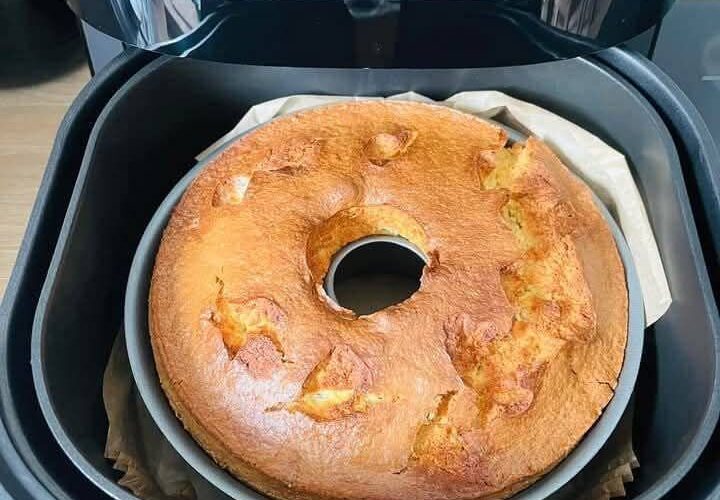
3 Ingredient Yogurt Cake – Yummy Recpie
Introduction & Background
The 3 Ingredient Yogurt Cake is one of the most elegant demonstrations of how baking, at its core, is not about complexity—but about balance, ratios, and controlled transformation of ingredients. While traditional cakes often rely on long ingredient lists—butter, sugar, oil, leavening agents, flavorings—this cake strips everything down to the essentials and still produces a complete, satisfying result.
This type of minimalist baking has gained massive popularity in recent years, particularly in places like the United States, where quick, efficient, and accessible recipes are in high demand. It appeals to home cooks, beginners, and even experienced bakers who want to explore the science behind simplified recipes.
At first glance, it seems impossible:
How can just yogurt, eggs, and flour create a cake?
The answer lies in understanding that these three ingredients collectively provide every structural and functional element required in baking:
- Structure → eggs + flour
- Moisture → yogurt
- Stability → protein + starch interaction
- Lightness → air + steam expansion
This cake is not a traditional fluffy sponge, nor is it a dense custard. Instead, it sits beautifully in between:
a soft, moist, lightly airy cake with a creamy undertone
What This Cake Really Is (Structural Identity)
The 3 Ingredient Yogurt Cake is best described as a:
protein-starch stabilized, moisture-rich baked matrix with light aeration
It operates through three integrated systems:
1. Egg Protein Network
Provides structure, elasticity, and stability.
2. Starch Framework
Forms the backbone of the cake’s body.
3. Dairy Moisture System
Maintains softness and prevents dryness.
Unlike traditional cakes:
- There is no creaming method
- No reliance on butter-based aeration
- Minimal sugar structure (or none at all)
Instead, it behaves more like:
a hybrid between sponge cake and baked custard
Core Texture Goals (Professional Benchmark)
A perfectly executed version should achieve:
- Soft, tender crumb
- Moist but not wet interior
- Smooth, uniform structure
- Slight elasticity when pressed
- Light density (not airy like sponge, not heavy like cheesecake)
The ideal bite experience:
gentle softness → slight bounce → creamy finish
Ingredient System (Ultra Detailed Functional Breakdown)
1. Yogurt (Primary Moisture & Emulsion Component)
- 1 cup yogurt (Greek or regular)
Functional Roles:
- Hydrates flour
- Provides moisture retention
- Adds mild acidity (flavor + structure impact)
- Contributes fat (if full-fat yogurt is used)
- Enhances tenderness
Advanced Insight:
The acidity in yogurt slightly weakens gluten formation, leading to a softer crumb.
2. Eggs (Structural Backbone & Aeration Engine)
- 3–4 large eggs
Functional Roles:
- Provide protein structure
- Trap air when whisked
- Emulsify ingredients
- Stabilize the cake during baking
Scientific Insight:
Egg proteins denature and form a network that locks the cake’s shape once heated.
3. Flour (Starch Framework & Body Builder)
- ¾–1 cup all-purpose flour
Functional Roles:
- Provides structure through starch
- Absorbs liquid
- Supports expansion
Balance Note:
- Too much flour → dense, dry cake
- Too little → weak, collapsing structure
Deep Food Science Breakdown (Advanced Level)
1. Emulsion Formation (Initial Mixing Phase)
When yogurt and eggs combine:
- Fat and water phases mix
- Proteins stabilize the mixture
- Smooth batter forms
2. Air Incorporation (Aeration Phase)
During whisking:
- Air bubbles are introduced
- These expand during baking
- Contribute to lightness
3. Protein Denaturation (Structure Formation)
As heat rises:
- Egg proteins unfold
- Bond together
- Form a stable network
4. Starch Gelatinization (Body Development)
Flour absorbs heat and moisture:
- Swells
- Thickens
- Strengthens structure
5. Steam Expansion (Volume Increase)
Water in yogurt converts to steam:
- Expands batter
- Creates lift
- Adds lightness
6. Moisture Retention System
Yogurt ensures:
- Soft crumb
- Prevents dryness
- Extends shelf life
7. Cooling Stabilization Phase
After baking:
- Proteins firm up
- Moisture redistributes
- Texture stabilizes
Step-by-Step Method
Step 1: Ingredient Temperature Control
Bring ingredients to room temperature.
This ensures:
- Better mixing
- Smoother batter
Step 2: Preheat Oven
Preheat to 170–180°C (338–356°F).
Line a cake pan.
Step 3: Egg Preparation (Critical Step)
Whisk eggs thoroughly.
For better texture:
- Beat until slightly foamy
- Incorporate air
Step 4: Yogurt Integration
Add yogurt slowly.
Mix until fully smooth.
Step 5: Flour Addition
Sift flour gradually.
Fold gently.
Avoid overmixing.
Step 6: Batter Consistency Check
Batter should be:
- Smooth
- Lump-free
- Slightly thick but pourable
Step 7: Pouring Batter
Transfer into pan.
Tap lightly to remove large air bubbles.
Step 8: Baking Phase
Bake for 35–50 minutes.
Look for:
- Set center
- Light golden top
Step 9: Cooling Phase (Critical)
Cool completely before slicing.
Prevents collapse and gumminess.
Texture & Flavor Profile
Perfect yogurt cake delivers:
- Soft, moist crumb
- Slight tang from yogurt
- Mild, natural sweetness
- Smooth and creamy mouthfeel
- Light, satisfying density
Common Mistakes & Fixes
Dense Cake
Cause: Overmixing
Fix: Fold gently
Wet or Gummy Center
Cause: Underbaking
Fix: Bake longer
Dry Texture
Cause: Too much flour
Fix: Adjust ratio
Flat Cake
Cause: Poor aeration
Fix: Beat eggs more
Cracked Top
Cause: High heat
Fix: Lower temperature
Advanced Variations
Sweet Version
Add sugar or honey.
Lemon Yogurt Cake
Add zest and juice.
Chocolate Version
Add cocoa powder.
Protein-Enriched Version
Add protein powder.
Gluten-Free Version
Use alternative flour blends.
Storage & Shelf Life
- Room temperature: 2 days
- Refrigerator: 4–5 days
- Freezer: up to 1 month
Serving Ideas
- With fresh fruit
- With honey drizzle
- With yogurt topping
- As breakfast cake
- As light dessert
Final Thoughts
The 3 Ingredient Yogurt Cake is a masterclass in simplicity and baking science. It demonstrates that complex results do not always require complex methods—only a deep understanding of how ingredients interact.
It delivers:
- Minimal ingredients
- Soft, moist texture
- Reliable results
- Versatility
At its core, it proves:
When protein, starch, and moisture are perfectly balanced and carefully baked, even the simplest combination of ingredients can transform into a structured, soft, and satisfying cake that feels far more complex than it actually is.
