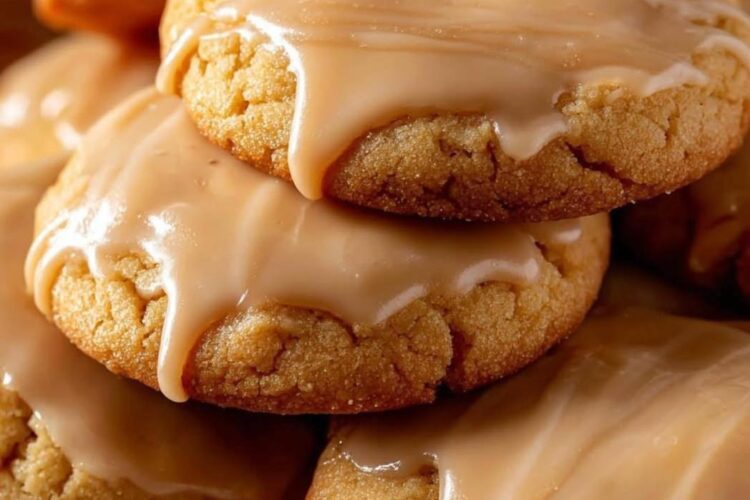
Maple Sugar Cookies with Sweet Maple Glaze
Introduction & Background
Maple Sugar Cookies with Sweet Maple Glaze are not just cookies—they are a carefully engineered balance of fat, sugar, moisture, and heat, designed to create a dessert that is soft, flavorful, and visually elegant. These cookies bring together the comforting richness of butter and the deep, caramel-like sweetness of maple syrup into a perfectly structured baked good.
Maple as an ingredient has a long culinary history, especially in regions like Canada and the northern United States, where maple syrup production is both a tradition and a science. Unlike refined sugar, maple syrup introduces not just sweetness, but complex flavor compounds, minerals, and moisture, all of which significantly influence baking behavior.
This recipe is designed to go far beyond a standard cookie. It focuses on:
- Precise texture engineering (soft center + slight crisp edge)
- Flavor layering (butter + maple + vanilla)
- Moisture balance control
- Professional glaze application and setting
The final result should be:
- Soft and tender inside
- Lightly crisp on the edges
- Rich but not overly sweet
- Finished with a smooth, glossy maple glaze
What This Recipe Really Is (Structural Identity)
These cookies are best described as:
a butter-based, partially aerated, moisture-balanced cookie system enhanced with liquid sugar (maple syrup) and finished with a crystallizing glaze layer
They involve three primary systems:
1. Dough Structure System
Butter + flour + egg create the base framework.
2. Moisture & Sugar System
Maple syrup modifies texture and softness.
3. Glaze System
A sugar solution that dries into a smooth coating.
Core Texture Goals (Professional Benchmark)
A perfect maple sugar cookie must achieve:
- Soft, tender center that yields easily
- Slightly crisp outer edge for contrast
- Even, fine crumb structure
- Slight chewiness from moisture retention
- Smooth glaze that sets without becoming brittle
The ideal bite progression:
light edge crisp → soft center → melt-in-mouth sweetness → maple finish with smooth glaze coating
Ingredient System (Ultra Detailed Functional Breakdown)
PART 1: COOKIE DOUGH SYSTEM
1. Butter (Primary Fat Matrix & Texture Engine)
- ¾ cup (170g) unsalted butter, softened
Functional Roles:
- Provides richness
- Coats flour proteins → limits gluten development
- Contributes to tender crumb
- Aids in slight crisping at edges
Advanced Insight:
Butter contains both fat and water. During baking, water evaporates, contributing to slight lift and texture.
2. Sugar (Structural Sweetener & Aeration Partner)
- ¾ cup granulated sugar
Functional Roles:
- Sweetens
- Helps create structure
- Assists in air incorporation during creaming
- Promotes browning
3. Maple Syrup (Liquid Sugar & Moisture Modifier)
- ¼ cup pure maple syrup
Functional Roles:
- Adds distinct maple flavor
- Increases moisture → softer cookies
- Reduces crispness slightly
- Enhances browning
Critical Note:
Maple syrup is hygroscopic (retains moisture), which helps keep cookies soft for longer.
4. Egg (Protein Binder & Emulsifier)
- 1 large egg
Functional Roles:
- Binds ingredients
- Provides protein structure
- Helps emulsify fat and liquid
5. Flour (Structural Framework)
- 2 cups all-purpose flour
Functional Roles:
- Provides starch
- Forms the backbone of the cookie
- Controls spread
6. Baking Soda (Leavening & Spread Regulator)
- ½ tsp
Functional Roles:
- Encourages slight spread
- Creates lightness
- Affects browning through pH changes
7. Salt (Flavor Balancer)
- ½ tsp
Functional Roles:
- Enhances sweetness
- Balances flavors
8. Vanilla Extract (Flavor Amplifier)
- 1 tsp
Functional Roles:
- Deepens overall flavor
- Complements maple
PART 2: MAPLE GLAZE SYSTEM
1. Powdered Sugar (Glaze Base)
- 1–1½ cups
Function:
- Provides smooth, dissolvable sweetness
- Forms glaze structure
2. Maple Syrup (Flavor Carrier)
- 2–3 tbsp
Function:
- Adds flavor
- Provides liquid
3. Milk or Cream (Consistency Control)
- 1–2 tbsp
Function:
- Adjusts thickness
4. Optional Butter (Gloss Enhancer)
- 1 tsp melted
Function:
- Adds shine
- Improves mouthfeel
Deep Food Science Breakdown (Advanced Level)
1. Creaming Method (Air Incorporation System)
Beating butter and sugar:
- Traps air pockets
- Creates lighter texture
- Influences final crumb
2. Moisture Balance & Retention
Maple syrup:
- Adds liquid
- Retains moisture after baking
- Prevents cookies from drying out
3. Spread Control Mechanism
Cookie spread depends on:
- Butter softness
- Sugar ratio
- Flour content
- Dough temperature
4. Gluten Development Control
Minimal mixing ensures:
- Less gluten formation
- Softer cookies
5. Caramelization & Browning
Sugars:
- Brown during baking
- Create flavor complexity
6. Glaze Crystallization
As glaze dries:
- Water evaporates
- Sugar crystallizes
- Smooth coating forms
Step-by-Step Method (Ultra Detailed Execution)
Step 1: Butter & Sugar Creaming
Beat until:
- Light and fluffy
- Pale in color
This step determines softness.
Step 2: Add Wet Ingredients
Mix in:
- Egg
- Maple syrup
- Vanilla
Blend until smooth.
Step 3: Dry Ingredient Integration
Combine:
- Flour
- Baking soda
- Salt
Add gradually.
Step 4: Dough Formation
Mix gently.
Avoid overmixing.
Step 5: Chilling Phase (Critical)
Refrigerate for 1 hour.
This:
- Firms butter
- Controls spreading
- Enhances flavor
Step 6: Shaping
Roll into balls or scoop evenly.
Step 7: Baking Phase
Bake at 175°C (350°F) for 10–13 minutes.
Edges should be lightly golden.
Centers should remain soft.
Step 8: Cooling Phase
Cool completely before glazing.
Step 9: Glaze Preparation
Mix until:
- Smooth
- Pourable
- Lump-free
Step 10: Glazing Technique
Drizzle or spread evenly.
Let set at room temperature.
Texture & Flavor Profile
Perfect cookies deliver:
- Soft, tender center
- Slight crisp edges
- Rich maple flavor
- Smooth glaze finish
- Balanced sweetness
Common Mistakes & Fixes
Flat Cookies
Cause: Warm dough
Fix: Chill dough longer
Dry Cookies
Cause: Overbaking
Fix: Reduce time
Hard Texture
Cause: Too much flour
Fix: Measure accurately
Runny Glaze
Cause: Too much liquid
Fix: Add powdered sugar
Cracked Glaze
Cause: Too thick
Fix: Add milk
Advanced Variations
Brown Butter Maple Cookies
Use browned butter for deeper flavor.
Cinnamon Maple Version
Add cinnamon.
Nutty Version
Add pecans or walnuts.
Salted Maple Cookies
Add flaky salt on top.
Gluten-Free Version
Use gluten-free flour blend.
Storage & Shelf Life
- Room temp: 3–5 days
- Airtight container recommended
- Freezer: up to 2 months
Serving Ideas
- With tea or coffee
- As dessert
- Holiday treats
- Gift boxes
Final Thoughts
Maple Sugar Cookies with Sweet Maple Glaze are a perfect blend of science and comfort. By carefully balancing fat, sugar, and moisture, and finishing with a well-structured glaze, you can create cookies that are soft, flavorful, and visually beautiful.
They deliver:
- Bakery-quality texture
- Rich maple flavor
- Perfect sweetness balance
- Elegant presentation
At their core, they prove:
When butter, sugar, and maple syrup are carefully balanced and baked with precision, a simple cookie dough can transform into a soft, tender, and beautifully glazed dessert that combines comfort, sophistication, and irresistible flavor in every bite.
