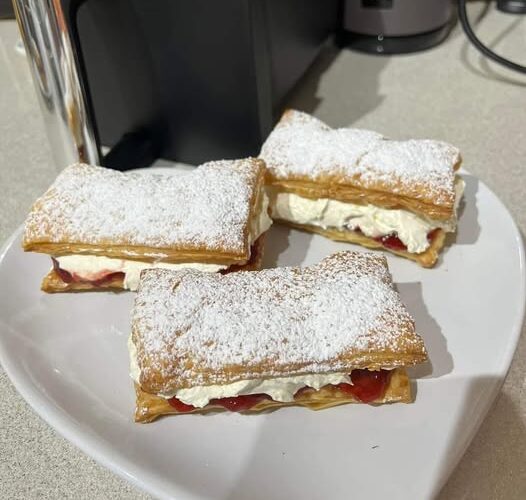
Air Fryer Puff Pastry – Recipe
Introduction & Background
Puff pastry is one of the most technically impressive creations in baking—a dough that transforms from flat, simple layers into a dramatically risen, golden, flaky structure with hundreds of delicate sheets. Traditionally, achieving this result requires precise oven control, careful lamination, and exact timing.
However, with the rise of modern kitchen appliances, especially the air fryer, puff pastry can now be prepared faster while still delivering bakery-level results—if you understand how to adapt the process correctly.
Air fryer cooking has surged in popularity across the United States and beyond, largely because it combines speed, efficiency, and strong heat circulation. But puff pastry is extremely sensitive to heat, fat distribution, and airflow—meaning small mistakes can ruin its structure.
This guide is designed to go far beyond a simple recipe. It explains:
- The full science behind puff pastry
- How lamination works
- How air fryer heat affects structure
- How to achieve perfect flakiness every time
What Puff Pastry Really Is (Structural Identity)
Puff pastry is not just dough—it is a multi-layered steam-leavened structure system.
It consists of:
- Alternating layers of dough and butter
- Hundreds of ultra-thin sheets
- Carefully preserved fat barriers
When baked:
- Butter melts → releases water
- Water turns into steam
- Steam expands → pushes layers apart
- Dough sets → locks structure in place
This creates the signature “puff.”
Core Structural Principle
Steam + fat separation + rapid heat = puff pastry rise
If any of these fail:
- No puff
- Dense layers
- Greasy texture
Why Air Fryer Puff Pastry Is Challenging
Air fryers behave very differently from ovens:
| Factor | Oven | Air Fryer |
|---|---|---|
| Heat Distribution | Even | Direct & intense |
| Airflow | Moderate | High-speed circulation |
| Cooking Space | Large | Compact |
| Browning Speed | Gradual | Very fast |
This means:
- Puff pastry rises faster
- Tops brown quickly
- Bottoms can overcook
- Layers can dry out if overexposed
To succeed, you must control temperature, spacing, and timing precisely.
Texture Goals (Perfect Result Standard)
A perfectly cooked air fryer puff pastry should have:
- Deep golden brown exterior
- Crisp outer shell
- Visible flaky layers
- Light, airy interior
- Buttery aroma
- No sogginess or collapse
When broken open, you should see distinct layered sheets—not a solid mass.
Ingredients (Expanded System Breakdown)
Primary Component: Puff Pastry
Option 1: Store-Bought (Recommended)
- 1 sheet frozen puff pastry (thawed)
Advantages:
- Pre-laminated with precision
- Consistent layering
- Ideal for air fryer beginners
Option 2: Homemade Puff Pastry (Advanced)**
Made using:
- Flour
- Cold butter
- Water
- Salt
Requires:
- Folding (turns)
- Resting periods
- Temperature control
Optional Components
Egg Wash
- 1 egg + 1 tbsp water
Function:
- Promotes browning
- Adds shine
- Enhances crispness
Fillings (Optional but Popular)**
- Cheese
- Chocolate
- Jam
- Savory meats or vegetables
Rule:
Filling must not release too much moisture.
Deep Technical Breakdown (Advanced Baking Science)
1. Lamination Mechanics (Layer Creation System)
Lamination is the process of folding butter into dough repeatedly.
Each fold multiplies layers:
- 1 fold → several layers
- Multiple folds → hundreds of layers
Each layer acts as a barrier between dough sheets.
2. Steam Generation System
Butter contains water.
During cooking:
- Water evaporates
- Turns into steam
- Expands rapidly
Steam pressure pushes layers upward, creating height.
3. Fat Barrier Function
Butter layers:
- Prevent dough layers from merging
- Allow independent expansion
- Create flakiness
If butter melts too early → layers collapse.
4. Heat Shock & Oven Spring Equivalent
Initial heat exposure is critical.
In the air fryer:
- Rapid heat creates immediate steam
- Layers separate quickly
- Structure begins forming
Too low heat → no puff
Too high heat → burns before rising
5. Airflow Dynamics in Air Fryer
Air fryers use powerful fans:
- Circulate hot air rapidly
- Dry outer surface quickly
- Crisp layers faster
But excessive airflow can:
- Dry pastry too much
- Cause uneven browning
6. Moisture Evaporation Balance
During cooking:
- Water evaporates
- Layers dry and crisp
- Internal structure stabilizes
Too much moisture:
- Soggy pastry
Too little moisture:
- Dry, brittle texture
7. Structural Setting Phase
As heat continues:
- Dough proteins set
- Starch gelatinizes
- Layers become rigid
This locks the puff in place.
Step-by-Step Method (Ultra Detailed Execution)
Step 1: Proper Thawing
If using frozen pastry:
- Thaw in fridge (not room temp)
- Keep cold but flexible
Warm pastry = melted butter = no layers.
Step 2: Rolling & Preparation
Lightly roll pastry if needed.
Do NOT press too hard—this destroys layers.
Step 3: Cutting Shapes
Cut evenly sized pieces:
- Squares
- Rectangles
- Circles
- Twists
Sharp cuts preserve layers.
Step 4: Add Fillings Carefully
- Keep fillings centered
- Avoid overfilling
- Seal edges lightly
Too much filling prevents puffing.
Step 5: Apply Egg Wash
Brush lightly on top only.
Avoid edges to prevent sealing layers.
Step 6: Preheat Air Fryer
Preheat to 175–180°C (347–356°F).
This ensures immediate puff.
Step 7: Basket Arrangement
- Place in single layer
- Leave gaps between pieces
- Avoid overcrowding
Airflow = even cooking.
Step 8: Cooking Phase
Cook for 8–14 minutes depending on size.
Observe:
- Rapid rise in first few minutes
- Gradual browning
- Crisping of edges
Step 9: Midway Check
If needed:
- Rotate or flip
- Adjust positioning
Step 10: Cooling Phase
Let pastry rest for 5–10 minutes.
This allows:
- Layers to stabilize
- Crispness to improve
Texture & Flavor Profile
Perfect puff pastry delivers:
- Crisp outer crunch
- Light inner layers
- Buttery richness
- Subtle sweetness (if plain)
- Balanced moisture
Common Mistakes & Fixes
Flat Pastry
Cause: Butter melted before cooking
Fix: Keep dough cold
Burnt Top
Cause: High heat or too close to fan
Fix: Lower temperature
Soggy Bottom
Cause: Overcrowding or wet filling
Fix: Reduce moisture and space pieces
Uneven Puff
Cause: Poor lamination or cutting
Fix: Use sharp cuts and even thickness
Advanced Variations
Sweet Cinnamon Sugar Twists
Twist strips and coat in sugar.
Chocolate-Filled Pastry
Add chocolate inside layers.
Savory Cheese Rolls
Fill with cheese and herbs.
Fruit Danish Style
Add fruit and glaze after cooking.
Garlic Butter Puff Bites
Brush with garlic butter post-cooking.
Storage & Reheating
- Best eaten fresh
- Room temp: 1 day
- Reheat in air fryer for crispness
Avoid microwave—it softens layers.
Serving Ideas
- Breakfast pastries
- Party snacks
- Dessert base
- Tea-time treat
- Appetizers
Final Thoughts
Air Fryer Puff Pastry is a perfect example of how advanced baking techniques can be adapted to modern cooking tools. While puff pastry is traditionally considered complex, understanding its structure—layers, steam, fat, and heat—allows you to recreate bakery-quality results quickly and efficiently.
When mastered, it delivers:
- Crisp golden exterior
- Light, airy layers
- Rich buttery flavor
- Fast and convenient preparation
At its core, it proves:
Even the most delicate laminated dough can achieve perfect flakiness when heat, structure, and airflow are precisely controlled—even inside an air fryer.
