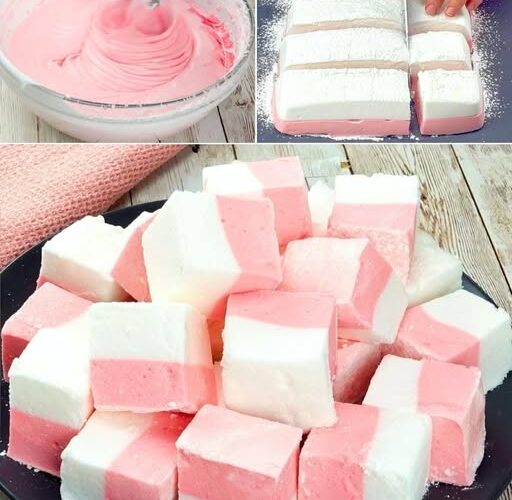
Soft & fluffy Pink Marshmallows – Recipe
Introduction & Background
Soft and fluffy marshmallows are one of the most iconic confections in modern dessert making because they are built almost entirely on structure rather than traditional baking. Unlike cakes or bread, marshmallows do not rely on flour, eggs, or gluten for stability. Instead, they are a carefully engineered foam made from sugar, gelatin, water, and air.
Historically, marshmallows were inspired by the root of the marshmallow plant, used in ancient Egypt and later in Europe for medicinal sweets. Over time, the recipe evolved into the modern candy we know today. In the contemporary dessert world, marshmallows are especially popular in the United States, where they are widely used in hot chocolate, s’mores, baking toppings, and gourmet candy shops.
This version focuses on creating ultra-soft, airy, pink marshmallows with a cloud-like texture, smooth bite, and delicate melt-in-mouth finish. The goal is not just sweetness, but structure precision—balancing elasticity, air retention, and sugar stability.
What These Marshmallows Really Are
These marshmallows are not “simple candy cubes.”
They are:
- A stabilized sugar foam
- A gelatin-based air matrix
- A temperature-controlled crystallized structure
- A moisture-balanced soft gel system
Each bite is the result of controlled chemistry, not just mixing ingredients.
Texture Goals (What Perfect Marshmallows Feel Like)
Perfect soft pink marshmallows should:
- Feel like a light sponge cloud
- Compress gently when pressed
- Bounce back slowly
- Melt smoothly in the mouth
- Have no grainy sugar texture
- Be soft but not collapsing
If you press them lightly, they should slowly spring back instead of staying flat or breaking.
Ingredients (Deep Functional Breakdown)
Gelatin System (Structure Backbone)
- 3 tbsp unflavored gelatin
- ½ cup cold water
Function:
- Forms the structural network
- Traps air bubbles
- Gives bounce and elasticity
- Stabilizes foam after whipping
Without gelatin, marshmallows cannot exist as a stable solid.
Sugar Syrup System (Sweet Structure Matrix)
- 2 cups granulated sugar
- ½ cup light corn syrup (or glucose syrup)
- ½ cup water
- Pinch of salt
Function:
- Creates sweetness and structure
- Prevents crystallization
- Stabilizes foam during whipping
- Controls final firmness
Corn syrup is especially important because it prevents sugar from crystallizing into grainy texture.
Flavor & Color System
- 1–2 tsp vanilla extract
- Pink food coloring (gel preferred)
Function:
- Adds aroma and dessert depth
- Provides visual appeal
- Enhances perceived sweetness
Dusting Coating System
- Powdered sugar
- Cornstarch
Function:
- Prevents sticking
- Keeps surface dry
- Maintains clean cutting edges
- Improves storage stability
Advanced Baking & Candy Science Breakdown
1. Gelatin Hydration and Network Formation
Gelatin is a protein derived from collagen. When hydrated:
- It absorbs cold water
- Swells into a gel-like structure
- Prepares for air trapping
When whipped, it forms a 3D protein lattice that locks in air bubbles.
This lattice is what gives marshmallows their signature bounce.
2. Sugar Syrup Phase Transformation
Heating sugar with water creates a controlled syrup system.
At this stage:
- Sugar dissolves completely
- Mixture becomes uniform
- Boiling removes excess water
The syrup must reach a precise temperature range so that:
- It is stable enough to set
- Soft enough to remain chewy
- Smooth enough to avoid crystallization
This is where texture is decided.
3. Air Whipping Expansion System
When syrup is combined with gelatin:
- Heat softens gelatin structure
- Mixer introduces air
- Volume increases rapidly
The mixture transforms from liquid to foam.
This stage is responsible for:
- Light texture
- Volume increase (2–3x expansion)
- Final fluffiness
4. Foam Stabilization Phase
As whipping continues:
- Gelatin begins cooling
- Foam becomes thicker
- Air bubbles stabilize
This is the transition from liquid foam to semi-solid structure.
If under-whipped → collapse
If over-whipped → dense marshmallows
5. Cooling and Setting Chemistry
Once poured into a tray:
- Gelatin firms up
- Moisture redistributes
- Foam locks into shape
This is where marshmallows become sliceable cubes.
6. Moisture Control System
Moisture balance is critical:
- Too much moisture → sticky marshmallows
- Too little moisture → hard, rubbery texture
Proper balance ensures:
- Soft bite
- Clean cutting
- Stable storage
7. Crystallization Prevention System
Corn syrup or glucose syrup prevents sugar crystals from forming.
Without it:
- Texture becomes grainy
- Marshmallows lose smoothness
- Structure weakens
This is a key professional baking step.
Step-by-Step Method (Expanded Execution)
Step 1: Prepare Pan Properly
Line a square or rectangular pan with parchment paper.
Dust generously with powdered sugar + cornstarch mix.
This prevents sticking and ensures clean removal.
Step 2: Bloom Gelatin (Activation Phase)
In a bowl:
- Add cold water
- Sprinkle gelatin evenly
- Let sit 10–15 minutes
Gelatin absorbs water and becomes spongy.
Step 3: Cook Sugar Syrup
In a saucepan:
- Combine sugar, corn syrup, water, and salt
- Heat until fully dissolved
- Bring to a gentle boil
Do not stir excessively during boiling.
Step 4: Combine Hot Syrup with Gelatin
Carefully pour hot syrup into bloomed gelatin.
- Mix immediately
- Ensure complete dissolution
- Avoid splashing
Step 5: Whipping Stage (Most Important Step)
Using a stand or hand mixer:
- Start on medium speed
- Gradually increase to high
Mixture will:
- Turn glossy
- Expand in volume
- Become thick and sticky
This may take 8–15 minutes.
Step 6: Add Flavor and Color
When mixture becomes thick:
- Add vanilla extract
- Add pink coloring
Mix until evenly distributed.
Step 7: Transfer to Pan
Pour mixture quickly before it sets.
- Smooth surface
- Tap lightly to remove air gaps
Step 8: Setting Phase
Leave at room temperature for:
- 6–10 hours
- Preferably overnight
Do not disturb during setting.
Step 9: Cutting Process
Once set:
- Dust top with sugar mix
- Lift from pan
- Cut into squares
- Coat all sides
Texture & Flavor Profile
Perfect marshmallows should deliver:
- Cloud-like softness
- Gentle elasticity
- Clean sugar sweetness
- Smooth melt on tongue
- Slight vanilla aroma
- No graininess
Common Mistakes & Fixes
Too Sticky
Cause: Insufficient coating or humidity
Fix: Increase sugar-cornstarch dusting
Too Hard
Cause: Overheated sugar syrup
Fix: Lower boiling intensity
Collapsed Foam
Cause: Under-whipping
Fix: Whip longer until thick
Not Setting
Cause: Weak gelatin
Fix: Use fresh gelatin and correct ratio
Variations
Strawberry Pink Marshmallows
Add strawberry powder or extract.
Chocolate Marshmallows
Add cocoa powder during mixing stage.
Vanilla Cloud Version
Increase vanilla for stronger aroma.
Layered Marshmallows
Pour different colored layers before setting.
Fruity Marshmallow Cubes
Add freeze-dried fruit powder.
Storage
- Airtight container required
- Room temperature: 1–2 weeks
- Avoid humidity exposure
- Do not refrigerate (can change texture)
Serving Ideas
- Hot chocolate topping
- S’mores filling
- Dessert decoration
- Snack on their own
- Mixed into baked goods
Final Thoughts
Soft and fluffy pink marshmallows are a perfect example of dessert engineering, where structure is built entirely through sugar chemistry, gelatin networks, and air incorporation.
When executed correctly, they deliver:
- Ultra-light texture
- Smooth melt-in-mouth experience
- Beautiful visual appeal
- Stable yet delicate structure
At their core, they prove:
Even without flour, eggs, or butter, a perfectly balanced system of gelatin, sugar, and air can create one of the softest and most enjoyable desserts in the world.
